Cook Islands 2010 TRAFALGAR Famous Naval Battle Tall Ship HMS Victory $1 Silver
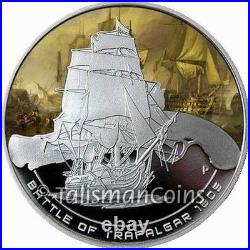
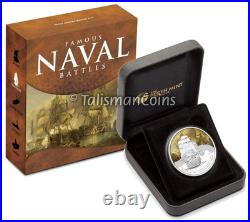
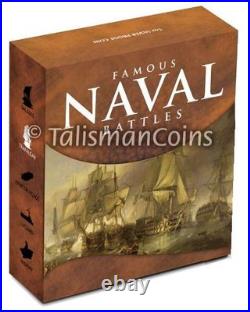
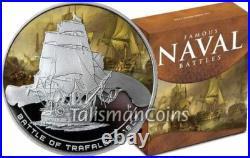
Nelson’s dramatic victory and his flagship. Over Napoleon Bonaparte’s fleet at Trafalgar is immortalized on this full color, pure silver proof! Talisman Coins and the Perth Mint are extremely pleased to present the new Famous Naval Battles Series. Following on the heels of the tremendously well received Famous Battles of History program, the Famous Naval Battles Series offers pure silver dollars commemorating five important naval conflicts that have shaped the course of history. All are remembered for their landmark contributions to the annals of naval warfare. The second salvo (if you will) is the Battle of Trafalgar, the British victory over Napoleon’s combined Franco-Spanish fleet that marked the beginning of the. And, along with the British victory over the Spanish Armada in 1588, bookended the Golden Age of Sail. The last successful invasion of Great Britain had taken place over seven hundred years earlier, by William the Conqueror, at the Battle of Hastings, in 1066 AD, but Napoleon apparently didn’t get the memo. He knew that the might of the Royal Navy stood in his way of a cross Channel invasion. Before his invasion flotilla could cross, however, Napoleon had to gain naval control of the English Channel – in his own words, Let us be masters of the Channel for six hours and we are masters of the world! Like the Spanish before him in 1588, and the Germans after him in 1940, his efforts would be doomed to failure, but not through lack of effort. In 1805, the First French Empire, under Napoleon Bonaparte, was the dominant military land power on the European continent, while the British Royal Navy controlled the seas. During the course of the war, the British imposed a naval blockade on France, which affected trade and kept the French from fully mobilizing their own naval resources. Napoleon’s naval plan in 1805 was for the French and Spanish fleets in the Mediterranean and Cádiz to break through the blockade and join forces. If Villeneuve encountered a British fleet of inferior numbers, he was to engage and destroy it, thus paving the way for the invasion of Great Britain! The Battle of Trafalgar. Often this led to inconclusive battles or allowed the losing side to reduce its losses. True to his personal style, Nelson planned a daring and unorthodox stratagem to utterly crush his opponent – he would break with all convention and sail directly at the enemy line, deliberately cutting it in two. Nelson’s plan was indeed a gamble, but a carefully calculated one. On 20 October Villeneuve’s fleet set sail for the Straits of Gibraltar. The British had plenty of warning, and set sail to bring the enemy to battle. Nelson was outnumbered and outgunned, the enemy totaling nearly 30,000 men and 2,568 guns to his 17,000 men and 2,148 guns. 27 British, and so could more readily combine their fire. By 13:00, the two fleets were engaged in a general melee, and superior British gunnery began to tell. The allied van, after long remaining quiescent, made a futile demonstration and then sailed away. The British captured 22 vessels of the Franco-Spanish fleet while losing none themselves. In terms of total casualties, the Battle of Trafalgar was equally lopsided: Napoleon’s fleet suffered nearly 13,000 sailors and soldiers killed, wounded or captured, versus only 1,666 casualties for the British. The battle was not kind to the commanders of the various fleets, either. Nelson was mortally wounded during the battle, becoming one of Britain’s greatest war heroes. Spanish Admiral Federico Gravina escaped with the remnant of the fleet, but succumbed months later to wounds he sustained during the battle. The British victory spectacularly confirmed the naval supremacy that Britain had established during the past century and was achieved in part through Nelson’s departure from the prevailing naval tactical orthodoxy, which involved engaging an enemy fleet in a single line of battle parallel to the enemy to facilitate signaling in battle and disengagement, and to maximize fields of fire and target areas. Nelson instead divided his smaller force into two columns directed perpendicularly against the larger enemy fleet, with decisive results. And the Death of Nelson. Is one of the most famous warships ever launched. She served in the American War of Independence, the French Revolutionary Wars and the Napoleonic Wars. She was Keppel’s flagship at Ushant, Jervis’s flagship at Cape St Vincent and Nelson’s flagship at Trafalgar. During that battle, Victory locked masts with the French. Which included a strong infantry corps (with three captains and four lieutenants), gathered for an attempt to board and seize. A musket bullet fired from the mizzentop of. Struck Admiral Nelson in the left shoulder, passed through his spine at the sixth and seventh thoracic vertebrae, and lodged two inches below his right scapula in the muscles of his back. He was carried below decks and died three hours later. Nelson’s body was placed in a cask of brandy mixed with camphor and myrrh, which was then lashed to the. Mainmast and placed under guard. Was towed to Gibraltar after the battle, and on arrival Nelson’s body was transferred to a lead-lined coffin filled with spirits of wine, for transport to England and a hero’s funeral. Decks mark the locations both where Nelson was shot and where he died. Nelson became – and remains – Britain’s greatest naval war hero, and an inspiration to the Royal Navy, yet his unorthodox tactics were only infrequently emulated by later generations. As we shall see in the fourth installment of the Famous Naval Battles Series, the Battle of Jutland, more initiative and risk-taking might have made a difference to a later generation of Royal Navy seamen. Once again, the Perth Mint has done history proud! Is deftly engraved and struck in frosted cameo relief in the center of the coin. The Battle of Trafalgar Pure Silver Proof is the second in the ongoing Famous Naval Battles series, to be released by the Perth Mint. The complete collection comprises: Salamis – 480 BC – Ancient triremes Trafalgar – 1805 AD – Nelson and. Napoleon Hampton Roads – 1862 AD – The duel between ironclads. Jutland – 1916 AD – Clash of the Dreadnoughts Midway – 1942 AD – Carrier vs. Please see the article further below for a short presentation on the Cook Islands. Admiral Horatio Lord Nelson’s flagship at the Battle of Trafalgar and one of the most famous and historic warships ever to sail, is depicted in frosted cameo relief. The battle itself is portrayed in color. The legend BATTLE OF TRAFALGAR 1805 defines the them. The Perth Mint’s “P” mint mark can be found at the 4:00 position near the edge. Her Majesty, Queen Elizabeth II, in crowned profile facing right. This portrait, featuring Her Majesty wearing a tiara and pearl drop earrings, was executed by the sculptor Raphael Maklouf. The legend QUEEN ELIZABETH II, the date of issue and denomination also appear. The coin is encapsulated inside a handsome taupe leatherette, clamshell-style presentation case, lined with black velvet and satin, and protected by a full-color outer box. An individually-numbered certificate of authenticity is included. Perth Mint of Australia. 999 Fine (Pure) Silver. Darryl Bellotti (obverse) Raphael Maklouf (reverse). The Cook Islands are a self-governing parliamentary democracy in free association with New Zealand. The fifteen small islands in this South Pacific Ocean country have a total land area of 92.7 square miles (240 square kilometers), but the Cook Islands Exclusive Economic Zone (EEZ) covers 700,000 square miles (1.8 million square kilometers) of ocean. As of the 2006 census, the country has a total population of just under 20,000. The main population centers are on the island of Rarotonga (14,153 as of 2006), where there is an international airport. There is also a much larger population of Cook Islanders in New Zealand, particularly the North Island. In the 2006 census, 58,008 New Zealanders identified themselves as being of ethnic Cook Island Maori descent. With over 90,000 visitors traveling to the islands in 2006, tourism is the Cook Islands’ number one industry, and the leading element of the economy, far ahead of offshore banking, pearls, marine and fruit exports. Defense is the responsibility of New Zealand, in consultation with the Cook Islands and at its request. In recent times, the Cook Islands have adopted an increasingly independent foreign policy.
